
Celebrating a Decade of Analyst-Driven Intelligence
10 years of building tools and tradecraft for defenders
Limited Series Podcast
TLDR: Key Takeaways
- Intelligence isn't measured by how much you produce - it's measured by how much uncertainty you remove. A quiet week with meaningful insight is often more valuable than dozens of reports that simply restate the news.
- Prioritization is a skill, not a process. Organizations don't become overwhelmed because there are too many threats. They become overwhelmed when everything is treated as the highest priority.
- Tools accelerate analysis, but they don't replace analytical judgment. Technology can collect, enrich, and organize data, but deciding what matters still depends on human experience and critical thinking.
- Most analysts eventually discover that attribution matters less than understanding risk. Knowing who conducted an operation is often less valuable to decision-makers than understanding whether it affects their organization.
- Clear communication prevents unnecessary panic. Small requests from leadership can unintentionally trigger major investigation efforts when analysts aren't given enough context about the actual objective.
- Writing less often requires thinking more. The strongest intelligence reporting isn't the longest - it's the version that communicates exactly what decision-makers need to know with as little friction as possible.
The Graphic That Sparked the Conversation
Show Notes
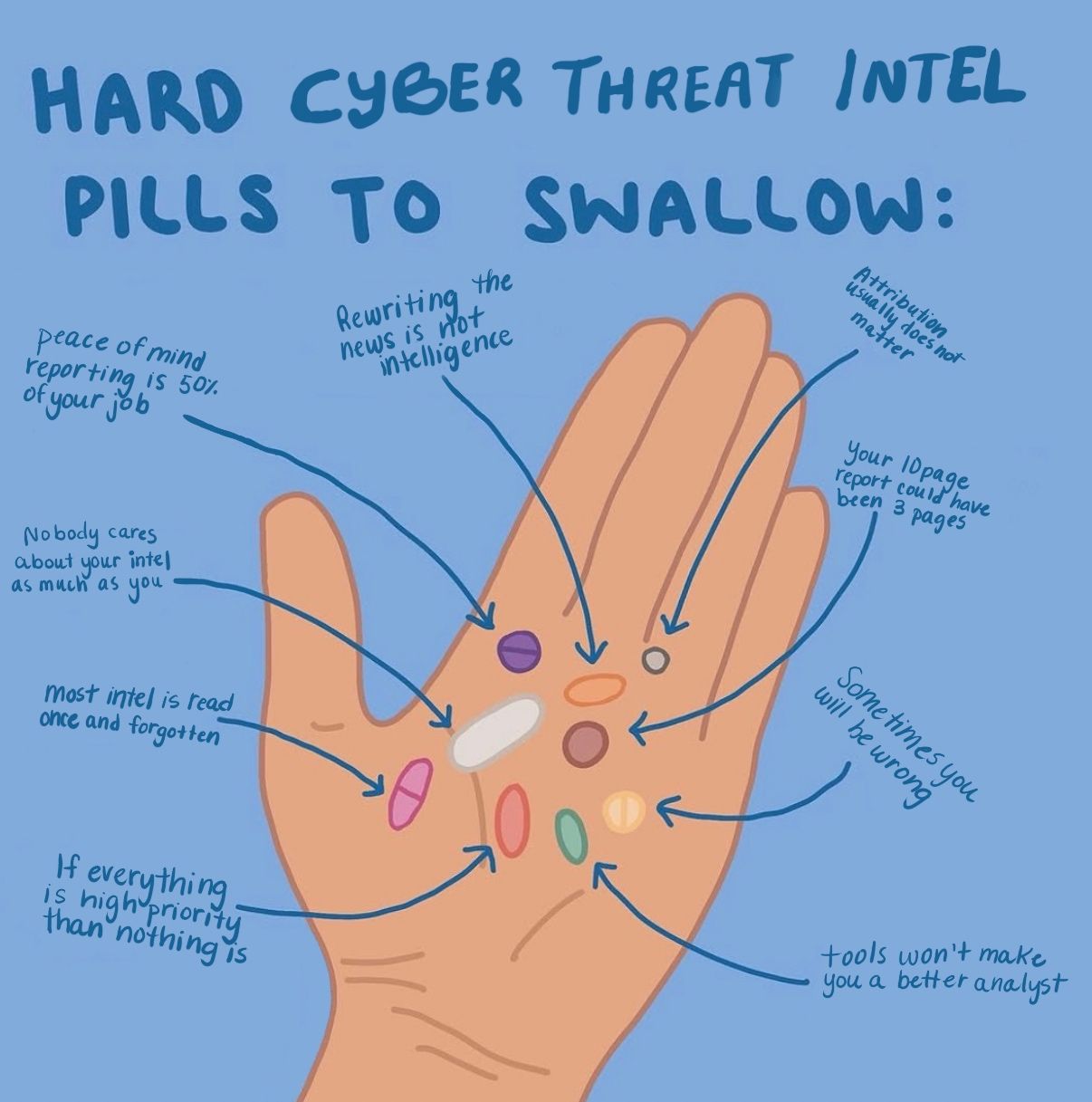
Nicole never expected her Hard Cyber Threat Intel Pills to Swallow graphic to resonate as widely as it did.
Inspired by an illustration about endometriosis, she adapted the format to capture frustrations she'd experienced throughout her own intelligence career. What surprised her wasn't simply the popularity of the graphic, it was how many analysts immediately recognized themselves in it.
Rather than generating debate over whether the observations were true, the response largely became one of shared recognition: these were conversations many practitioners had been having privately for years.
Why Enterprise CTI Changes Your Perspective
One of the strongest themes throughout the discussion is the difference between threat research and enterprise threat intelligence.
Threat researchers naturally gravitate toward understanding campaigns, actors, and the broader threat landscape. Enterprise intelligence teams, however, have a different responsibility: helping one organization make better security decisions. That shift changes what success looks like.
Interesting developments aren't automatically important. Attribution isn't always necessary. And many fascinating stories simply don't affect the business you're trying to protect.
Nicole argues that mature intelligence teams become better not by learning more about every threat, but by becoming more disciplined about which threats deserve attention.
Escaping the Panic Cycle
Modern CTI teams are constantly surrounded by breaking news, zero-day disclosures, and rapidly spreading social media discussions.
Nicole describes how analysts can easily become trapped in what she calls panic cycles, where every new headline feels urgent simply because everyone is talking about it.
Her recommendation is simple: instead of allowing the broader internet to dictate priorities, intelligence teams should continually return to their own organization's intelligence requirements.
One of the most valuable threat feeds isn't an external vendor at all - it's your own incident queue.
Understanding what is actually happening inside your environment often provides more useful intelligence than chasing every emerging headline.
Learning to Let Go of Attribution
Perhaps the most controversial takeaway centers around attribution. Nicole explains that while identifying threat actors can be deeply satisfying (and often essential for threat research) it isn't always what enterprise stakeholders actually need.
Leadership generally cares less about the evolution of a ransomware group's branding than they do about practical questions:
- Does this affect us?
- Are we vulnerable?
- What should we do next?
For enterprise CTI teams, actionable risk often matters more than naming the adversary.
Becoming a Better Intelligence Communicator
The conversation also explores one of the most overlooked analyst skills: communication.
Nicole argues that effective reporting isn't about demonstrating how much research was completed, it's about making decisions easier.
That means:
- writing concise reports,
- resisting the temptation to include every interesting detail,
- communicating confidence clearly,
- and understanding what different audiences actually need.
As she notes during the discussion, shortening a report often takes significantly more work than writing a long one.
Advice for New Analysts
When asked which "hard pills" every new analyst should accept early in their career, Nicole doesn't hesitate: you're going to be wrong sometimes (and that's okay). Threat intelligence is inherently probabilistic. Analysts routinely make judgments based on incomplete information, evolving evidence, and uncertain futures.
The goal isn't perfect prediction - the goal is producing thoughtful, transparent assessments that improve decision-making over time.
Resources Mentioned